
























McLaren Senna

The McLaren Senna honors Formula 1 legend Ayrton Senna. Therefore, its purpose is clear from the start. It exists to dominate the track.
Unlike luxury hypercars, the Senna focuses entirely on lap times. As a result, engineers shaped every component around performance. Moreover, they removed anything that did not improve speed or control.
Exterior Design & Active Aerodynamics
At first glance, the Senna looks extreme. However, every curve directs airflow.
For example, the large front splitter increases front-end grip. Meanwhile, deep air channels guide turbulence away from the body. In addition, the massive active rear wing adjusts automatically to optimize downforce.
Consequently, the car generates up to 800 kg of downforce at high speed. Because of this, it corners with exceptional stability.
Engine & Raw Performance
At its core, the Senna features a 4.0-liter twin-turbocharged V8. This engine produces 789 HP and 800 Nm of torque.
As a result, the car accelerates from 0–100 km/h in just 2.8 seconds. Furthermore, the 7-speed dual-clutch transmission delivers rapid gear changes. Therefore, power reaches the rear wheels instantly and aggressively.
Carbon Monocage & Weight Strategy
McLaren builds the Senna around its Monocage III carbon-fiber chassis. Engineers use carbon fiber extensively throughout the body and interior.
Because of this strategy, the dry weight stays around 1,198 kg. Consequently, the power-to-weight ratio exceeds 650 HP per ton.
Instead of adding comfort features, the team focused on reducing mass. Thus, every kilogram serves performance.
Suspension & Braking Control
The Senna uses RaceActive Chassis Control II suspension. This advanced system hydraulically links the dampers. As a result, it minimizes body roll during aggressive driving.
In addition, carbon-ceramic brakes provide immense stopping power. Meanwhile, Pirelli P Zero Trofeo R tires maximize mechanical grip.
Therefore, the Senna maintains control under extreme cornering and high-speed braking.
Interior: Driver-Focused Environment
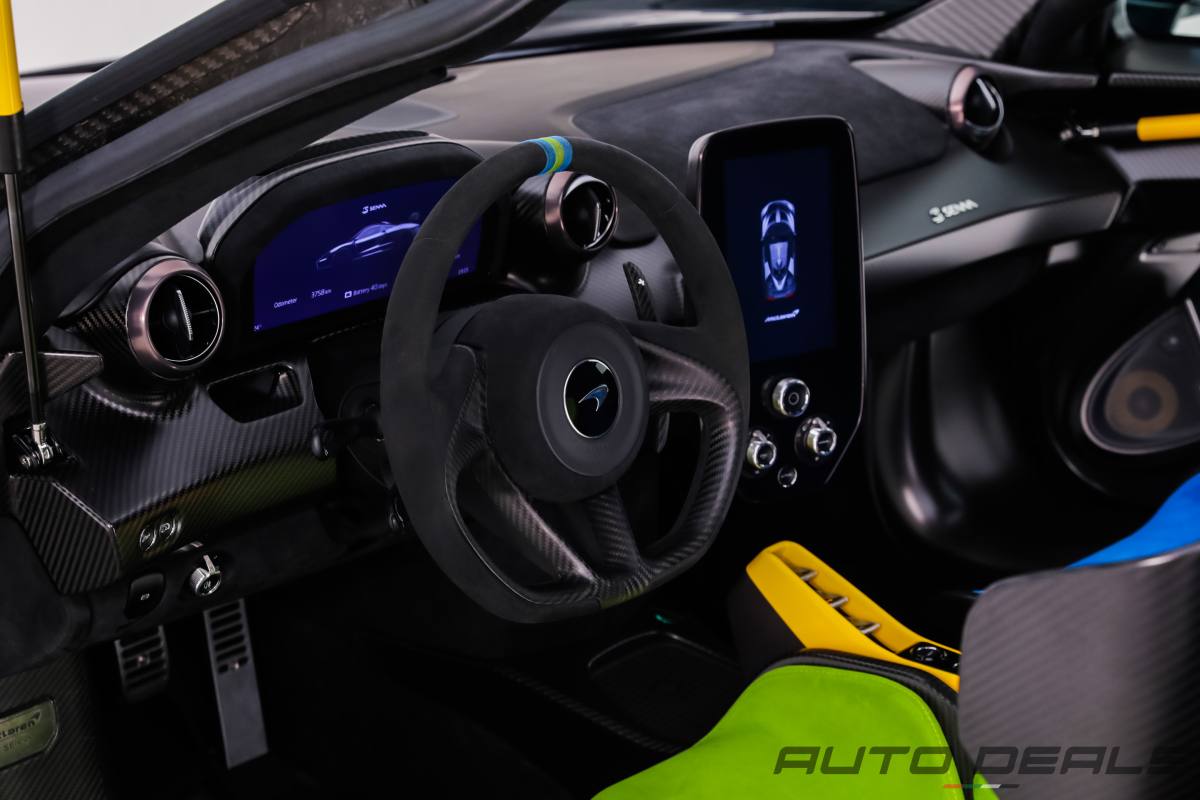
Inside, the cabin reflects pure motorsport influence. Designers kept the layout minimal and functional.
For instance, carbon fiber racing seats reduce weight. Additionally, the central screen provides essential driving data. Controls move to the roof console to free dashboard space.
Consequently, the cockpit keeps the driver fully engaged without distraction.
Exclusivity & Collector Appeal
McLaren limited production to just 500 units. As a result, exclusivity remains guaranteed.
Moreover, the Senna represents one of the most focused road-legal track cars ever created. Therefore, collectors value it not only for rarity but also for engineering purity.