
























A Century of Excellence: The Rolls-Royce Phantom Centenary Private Collection Arrives in Dubai
In October 2025, Rolls-Royce Motor Cars announced something extraordinary to commemorate a remarkable milestone: the completion of 100 years of Phantom production, the marque’s most iconic and prestigious vehicle. The response was the creation of the Phantom Centenary Private Collection—a strictly limited production run of just 25 vehicles, each representing 40,000 cumulative hours of master craftsmanship and priced at $3 million USD per vehicle.
This isn’t a specification variant or trim package. The Centenary Collection represents the most ambitious expression of bespoke automotive manufacturing ever attempted by Rolls-Royce, combining classical heritage aesthetics with contemporary luxury technology in ways that redefine what is possible in automotive design and execution.
For Dubai’s ultra-high-net-worth community and serious automotive collectors, the Phantom Centenary represents an unprecedented opportunity to acquire not merely a vehicle, but a documented masterpiece of automotive art.
A CENTURY OF AUTOMOTIVE SUPREMACY
The Rolls-Royce Phantom made its debut in 1925 and has served as the flagship of the marque through eight distinct generations spanning ten decades. Throughout its history, the Phantom has been the preferred conveyance of royalty, dignitaries, entertainment icons, and the world’s wealthiest individuals.
The roster of distinguished Phantom owners reads like a history of 20th and 21st-century fame and influence: Elvis Presley relied on his Phantom for privacy and prestige; Elton John owned multiple examples; contemporary icon Pharrell Williams counts a Phantom among his vehicle collection. The legendary fashion designer Karl Lagerfeld—arbiter of haute couture and visual sophistication—owned no fewer than three Phantoms during his lifetime, a testament to the vehicle’s status as the ultimate expression of refined taste.
Beyond celebrity ownership, the Phantom has served as official state transport for British royalty, diplomatic delegations, and heads of state worldwide. It is the car that appears at the most significant moments in global affairs and personal milestones of the extraordinarily wealthy.
The Phantom Centenary celebrates this legacy while simultaneously establishing new standards for bespoke luxury automotive manufacturing.
The Centenary wasn’t created by external design consultants or focus groups responding to market research. Instead, Rolls-Royce entrusted the project to its in-house team of master designers and craftspeople—the artisans who understand the brand’s heritage, manufacturing capabilities, and design language more intimately than anyone on Earth.
The process began with an ambitious artistic exploration: 147 detailed sketches explored every conceivable design direction. Through this iterative process of refinement, a singular vision emerged—a vehicle that would simultaneously honor 100 years of Phantom history while articulating a contemporary understanding of luxury and craftsmanship for the years ahead.
Every sketch contributed something to the final expression. The creative process was less about compromise and more about synthesis—combining the best ideas from multiple creative directions into a unified whole.
THE SPECIFICATIONS: PHANTOM EXTENDED WHEELBASE PLATFORM
The Centenary is built upon the Phantom VIII Extended Wheelbase chassis, the most spacious and luxurious Phantom configuration ever produced. The extended wheelbase adds 8.6 inches of rear-seat legroom compared to the standard version, creating what is essentially a mobile sanctuary for rear passengers.
Engine & Performance:
- Twin-turbocharged 6.75-liter V-12 engine
- 563 horsepower
- 664 lb-ft of torque
- 8-speed automatic transmission
- Rear-wheel drive
- 0-60 mph acceleration: 4.5 seconds
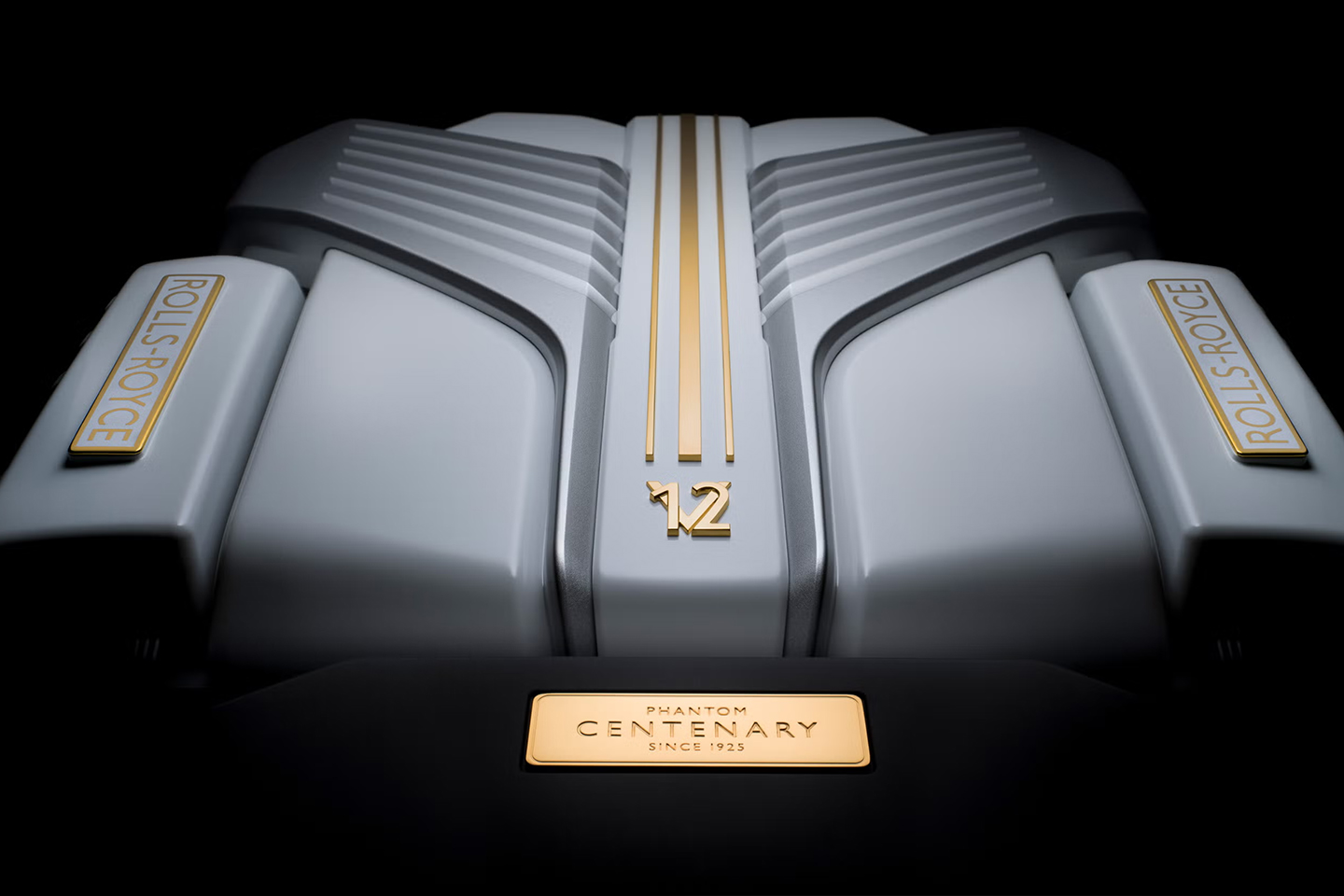
The engine itself becomes a design element in the Centenary—encased in a distinctive white and 24-karat gold cover visible through a transparent engine bay panel. Even the mechanical components are treated as art worthy of visual contemplation.

EXTERIOR DESIGN: A STUDY IN CONTRAST AND LUMINESCENCE
Two-Tone Paint: Hollywood Heritage Reimagined
The Centenary’s striking two-tone black and white exterior is more than an aesthetic choice—it’s a deliberate homage to 1930s Hollywood’s golden age, when Rolls-Royce Phantoms graced red carpets before color cinematography became standard. The paint scheme evokes the glamour of an era when these vehicles were icons of unstoppable prestige.
But the true artistry lies in the clear coat formulation. Rolls-Royce has infused pulverized champagne-colored glass particles into the transparent protective layer. The result is a paint finish that doesn’t merely reflect light—it captures, refracts, and dances with it, creating an effect of subtle luminescence that photographs cannot adequately convey. The finish must be experienced in person to appreciate its sophistication.
The Spirit of Ecstasy: Heritage Made Tangible
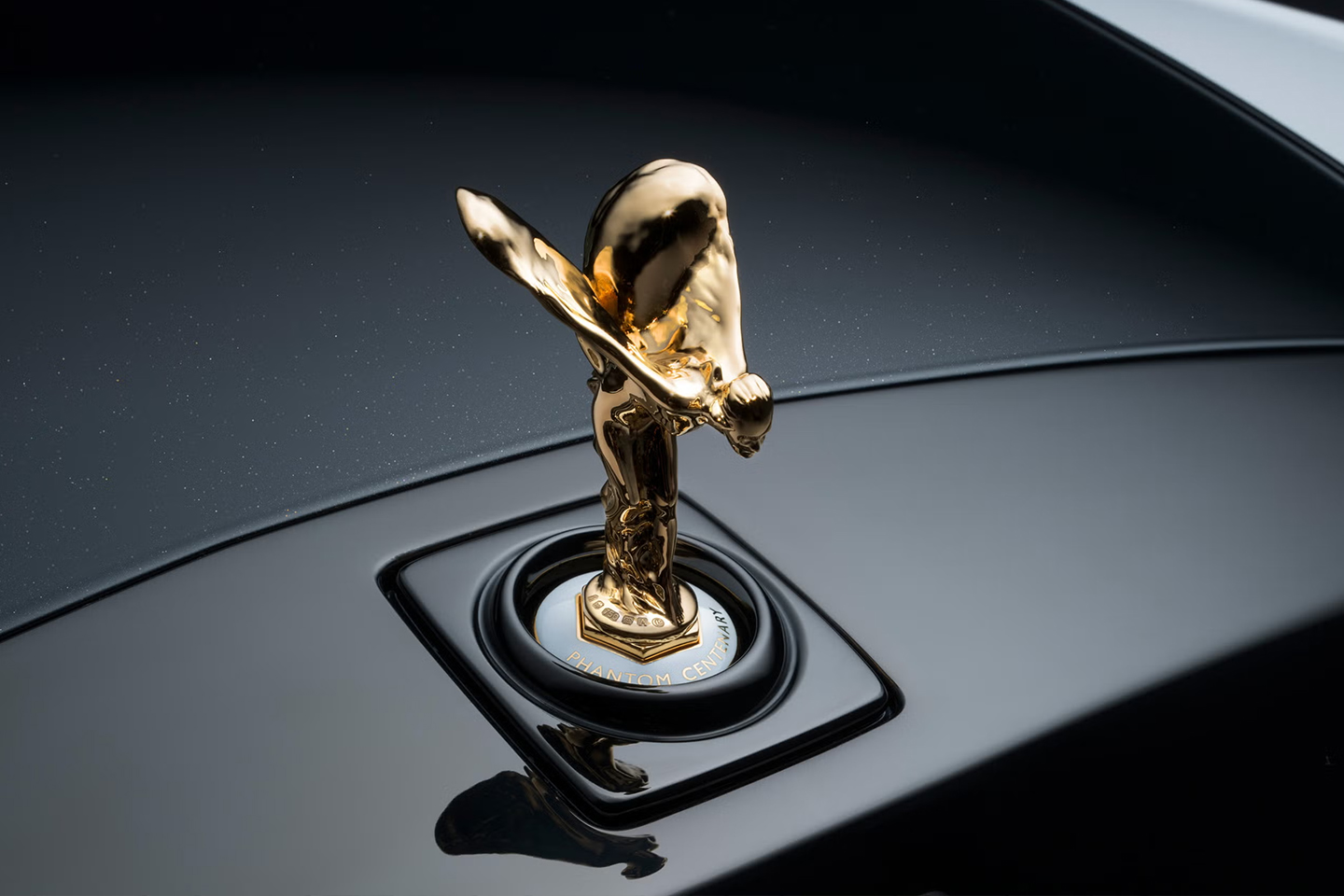
Crowning the hood is the signature Rolls-Royce emblem: the Spirit of Ecstasy. For the Centenary, this iconic figure has been crafted from 18-carat yellow gold for structural integrity, then overlaid with 24-karat gold plating for that unmistakable radiance. Each hood ornament is individually hallmarked by a London jeweller, creating a verifiable record of authenticity and precious metal content.
The design is meticulously based on the original Spirit of Ecstasy casting from 1925—a physical and symbolic connection between the brand’s centennial past and its present achievement. It is not a nostalgic reproduction but a thoughtful reinterpretation of heritage.
Wheel Artistry: The Number 100 Encoded
Each of the Centenary’s distinctive disc-faced wheels features 25 concentric lines meticulously engraved into its surface. Multiply 25 lines across four wheels, and you arrive at exactly 100—an elegant numerical tribute to the centennial occasion, hidden in plain sight.
INTERIOR BRILLIANCE: WHERE CRAFTSMANSHIP BECOMES POETRY
The Headliner: 440,000 Stitches Depicting Heritage
Above the heads of occupants blooms an extraordinary artistic achievement: a custom starlight headlining composed of 440,000 individual hand-placed stitches. This constellation of thread doesn’t randomly depict stars—rather, it illustrates a mulberry tree, drawn from a historical photograph of company founder Henry Royce seated beneath such a tree, engaged in conversation with his chief engine draftsman and lead test driver, discussing the future of the Phantom.
The mulberry tree is no mere romantic image. It represents a moment of creative genesis—the instant when automotive visionaries gathered to shape an icon’s destiny. Now, that moment is immortalized overhead, a reminder to every occupant that they travel beneath history itself.
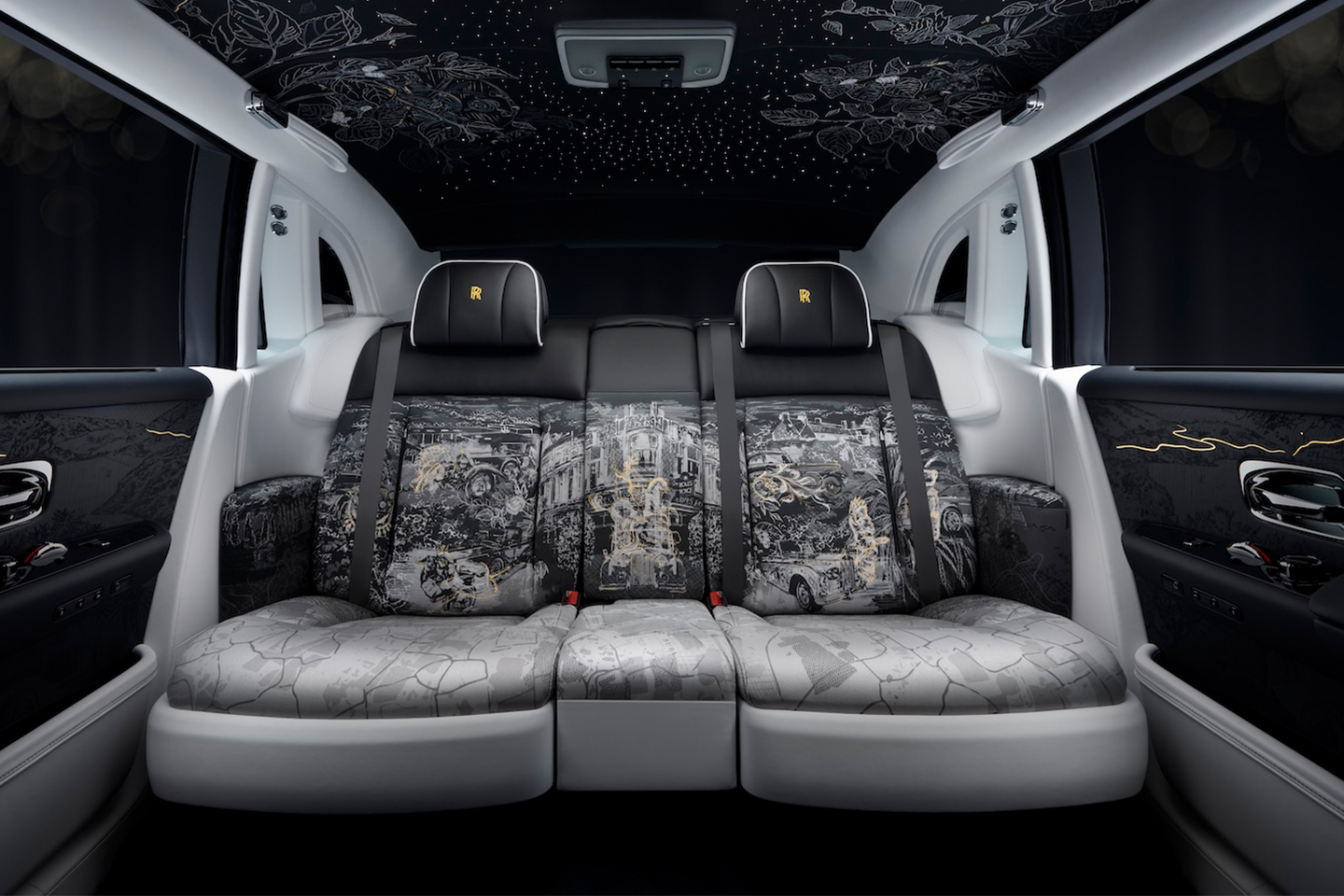
The Rear Seats: 160,000 Stitches of Historical Narrative
The rear seat installation represents the culmination of bespoke craftsmanship that required several years of development. Master textile specialist Brienny Dudley—who studied textile design at Arts University Bournemouth—led a three-person team in hand-weaving a complex tapestry spanning 45 separate panels that must align with absolute precision.
The construction process is extraordinary:
- Primary Layer: A detailed hand-woven tapestry created on bamboo twill fabric, containing 160,000 individual stitches
- Design References: The tapestry depicts significant locations in Phantom history, famous collectors’ imagery, and brand heritage elements
- Hidden Symbolism: Yellow bees throughout the design reference the 250,000 honeybees inhabiting the Goodwood Estate, where modern Phantoms are handcrafted
- Secondary Layers: Two additional layers of printed graphics subtly honor renowned Phantom collectors through related imagery—some references deliberately obvious, others intentionally mysterious
The seat composition invites discovery. Passengers seated in the Centenary’s rear aren’t simply relaxing in luxury—they’re observing a carefully curated museum of Phantom history, stitched into the very fabric of the vehicle.
The Front Seats: Project Code-Names and Creative Heritage
The driver and passenger seat patterns are laser-etched with imagery inspired by legendary Rolls-Royce development code-names:
- Roger the Rabbit: The internal designation for Rolls-Royce’s transformative 2003 relaunch, representing the brand’s renewal and contemporary relevance
- The Seagull: The codename for the original 1923 Phantom I prototype, representing the brand’s foundational vision
These references serve as automotive Easter eggs for the initiated—insider knowledge rewarding those who understand Rolls-Royce’s classified development history. It’s a form of bespoke storytelling available only to those who take time to truly engage with their vehicle’s details.
The Dashboard: 3D-Printed Heritage Integration
Just below the windshield, 50 three-dimensional aluminium fins curve elegantly across the dashboard fascia. Each fin is laser-etched with excerpts from historic Rolls-Royce press clippings—fragments of the brand’s documented legacy now integrated into the physical vehicle architecture.
This design choice represents sophisticated functional integration: the fins provide structural support for the dashboard while simultaneously serving as a historical archive. Form and function merge with narrative, creating a dashboard that is simultaneously contemporary and deeply rooted in heritage.
The Door Panels: Cartography of Prestige
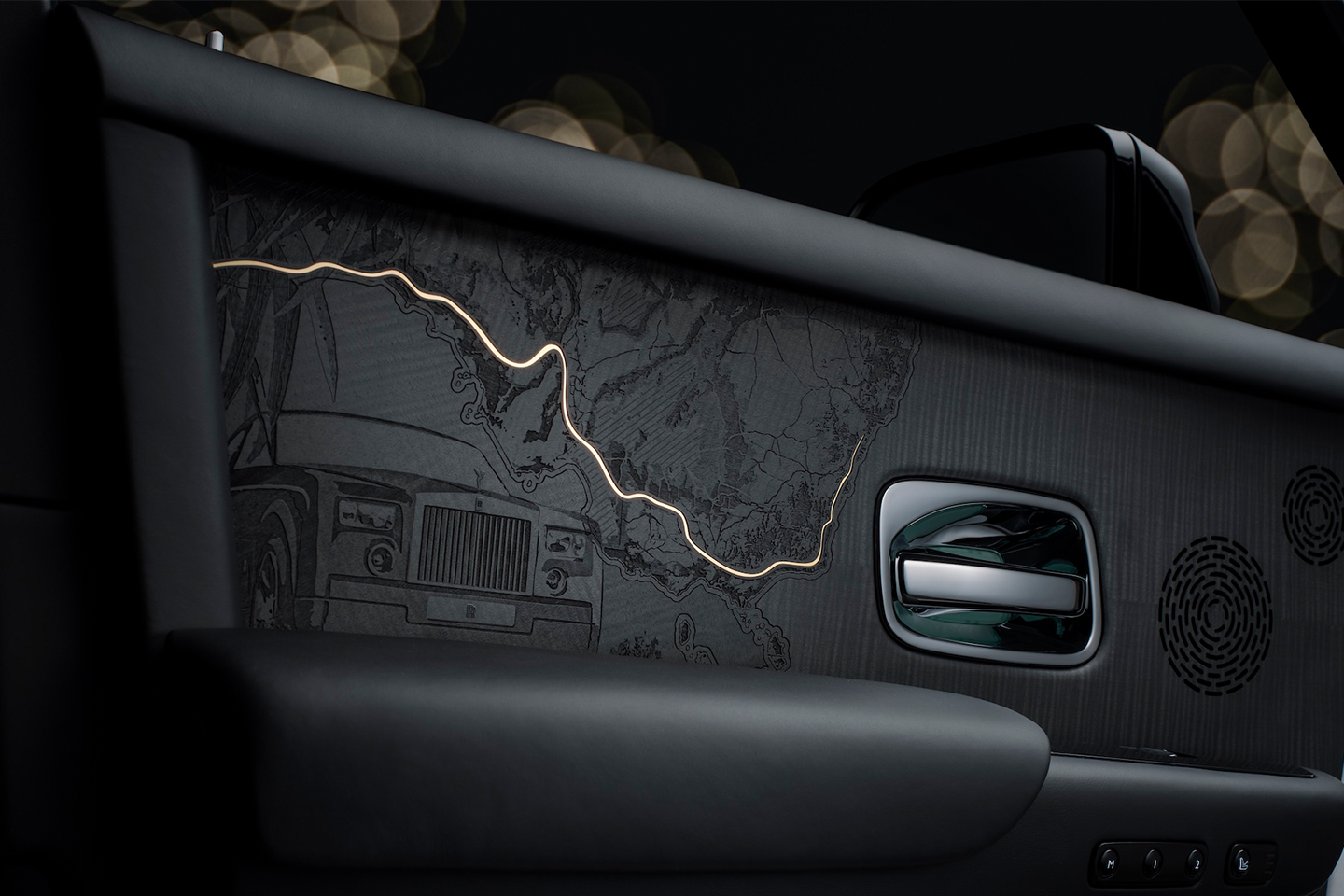
The door panels showcase perhaps the most visually striking interior element: an elaborate interplay of advanced manufacturing techniques, including:
- 3D Marquetry: Complex wood-working utilizing three-dimensional depth
- Laser-Etching: Precise digital engraving of fine details
- 3D-Ink Layering: Multi-dimensional color and depth achieved through layered ink deposition
- 24-Karat Gold Leaf: Applied selectively at microscopic thickness (0.1 micrometers)—a demonstration of restraint even in opulence
The door panels depict maps of globally significant locations in Phantom history—geographical landmarks where the brand has established its legacy, routes traveled by notable Phantoms, and journeys undertaken by royal and diplomatic vehicles. The interior becomes a navigational chart of prestige and privilege, reminding occupants that they travel not merely in a car, but as part of a continuum of automotive achievement.
The Phantom Centenary is hand-assembled at Goodwood Estate in West Sussex, United Kingdom, the global headquarters of Rolls-Royce Motor Cars since 2003. The manufacturing facility itself is an architectural and environmental achievement: designed by architect Sir Nicholas Grimsworth, it is bright, airy, clean, and naturally cooled by a living roof of hardy sedum plants that provide thermal insulation while supporting local ecology.
The Scale of Craftsmanship:
- 40,000 cumulative hours of collective labor per complete collection of 25 vehicles
- Approximately 1,600 hours per vehicle of specialized craftsmanship
- Skilled artisans from multiple disciplines, including textile specialists, woodworkers, painters, engineers, and electricians
- Hand-assembly process for every component, with no two vehicles identical
At Goodwood, each production station maintains a distinctive identity. A tiny flag indicates the regional destination where each completed vehicle will eventually reside, creating a sense of purpose and connection among craftspeople who understand they’re building something destined for the world’s most exclusive addresses.
Recent Posts


September 30, 2026